July 16, 2026|

Looking back at ARFTG-107
On June 12, 2026, the 107th ARFTG Microwave Measurement Conference once again closed out the International Microwave Symposium — this year at the Westin Boston Seaport, under the theme “Measuring the Future: High-Frequency Metrology for Intelligent, Connected, and Quantum Worlds.” With around 160 attendees, it was the best-attended ARFTG conference in ten years.

Impressions
Conference Highlights

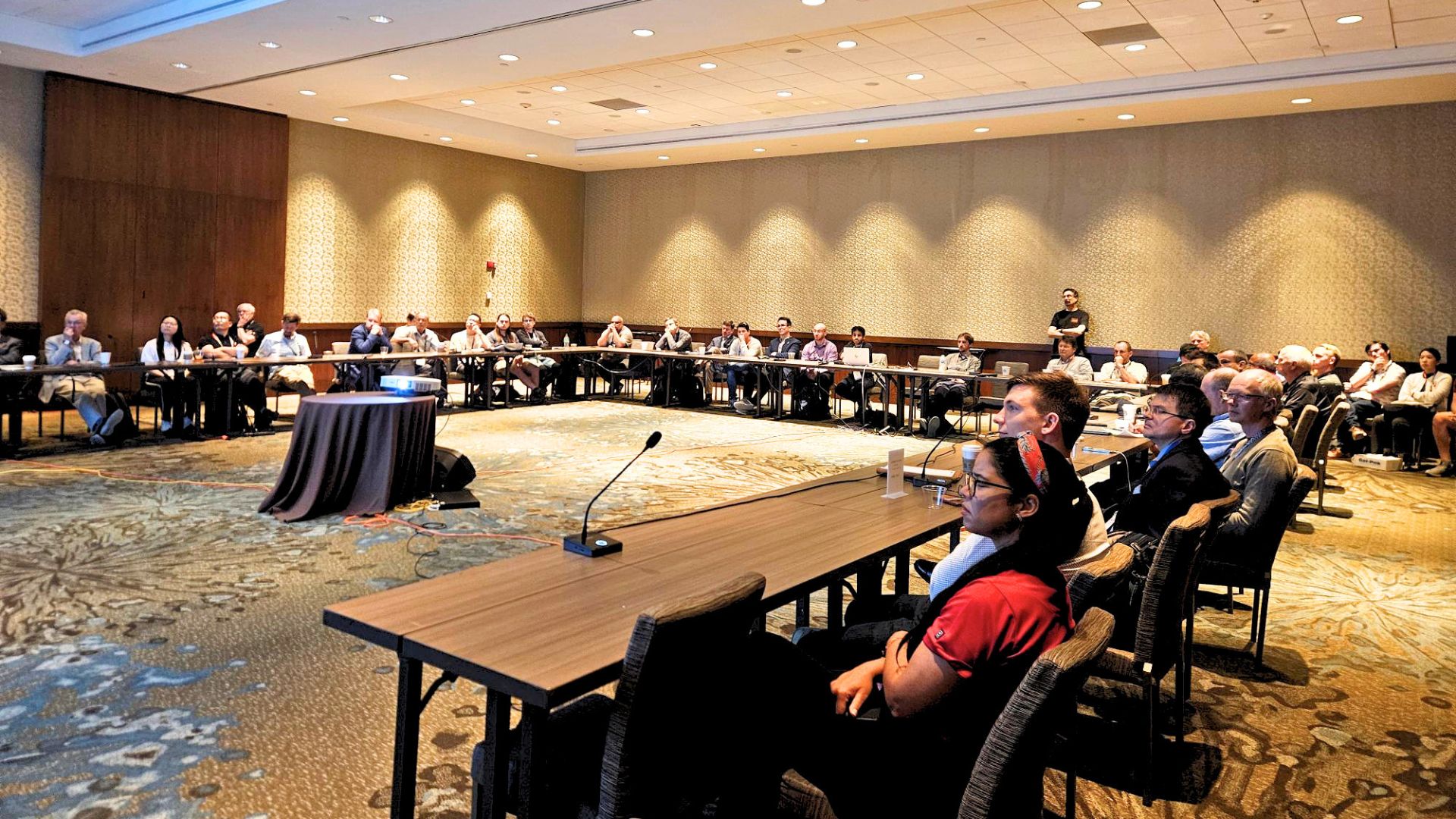
The conference opened Friday morning with NIST’s Nathan D. Orloff and his keynote on “The Evolution of Wafer-Level Metrology” — a walk from the state of the practice to the requirements for SI-traceability at the wafer level: a traceability chain for complex permittivity, a new wafer-level calibration kit with SI-traceable check standards and crosstalk correction to the probe tips, and, as the final hurdle ahead, wafer-level phase traceability.

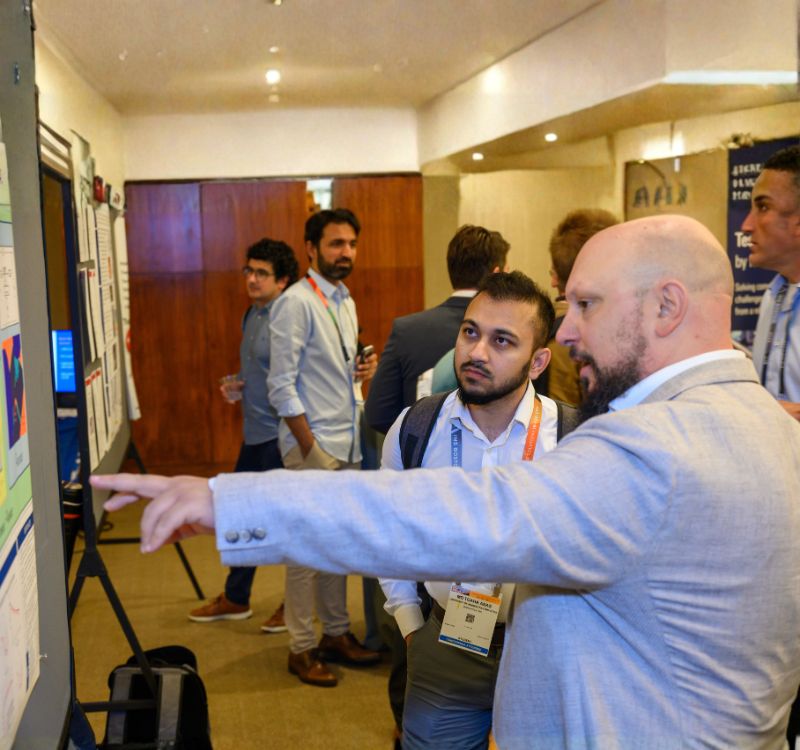
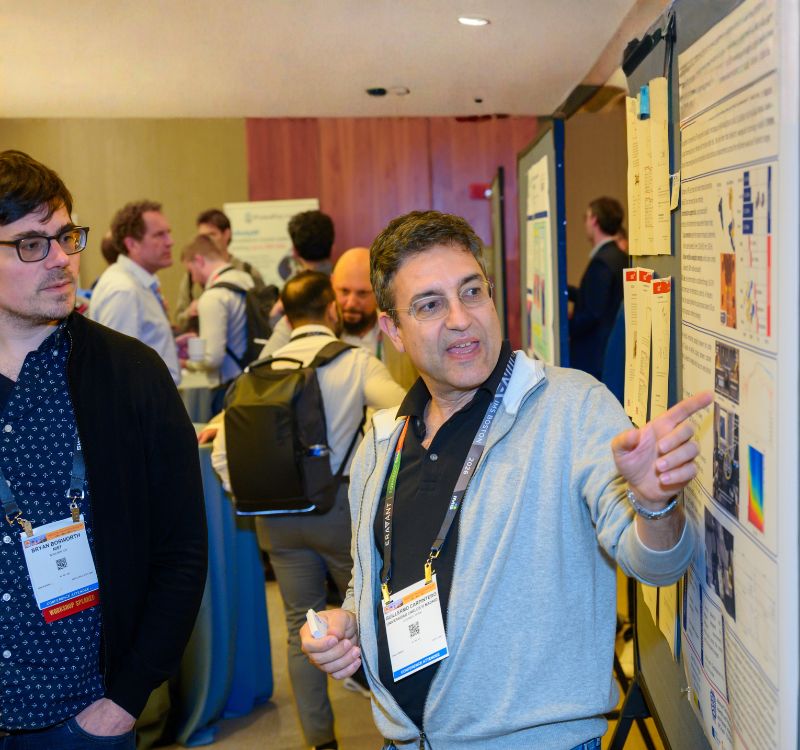
The keynote was the opener of the first of four sessions, alongside with the Interactive Forum:

ARFTG-107 Awards: Official voting results

At each conference, we ask our visitors to vote for the best contributions from a packed program. What surprised us this time: four of the seven winning papers are student papers. The next generation is setting the pace.
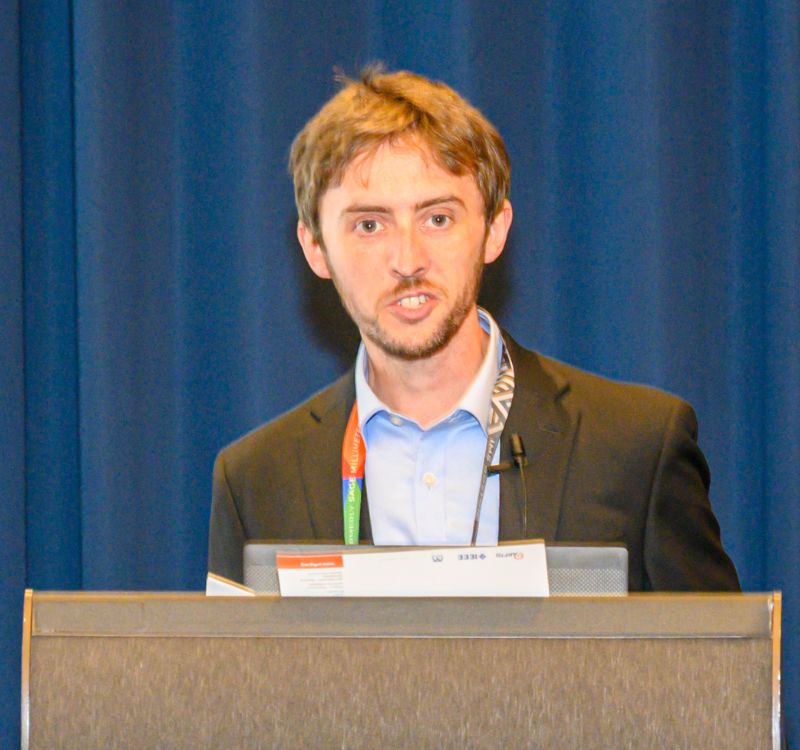
BEST ORAL PRESENTATIONS

Design and RF Performance Validation of a New Miniature Rectangular Waveguide Flange for Millimeter-wave Frequencies and Above (A3) James Skinner (NPL), Dave Richardson (Flann Microwave), Paul Hague (Flann Microwave), Nick Ridler (NPL)

Making the D-band flange smaller does not degrade repeatability or interface reflection.

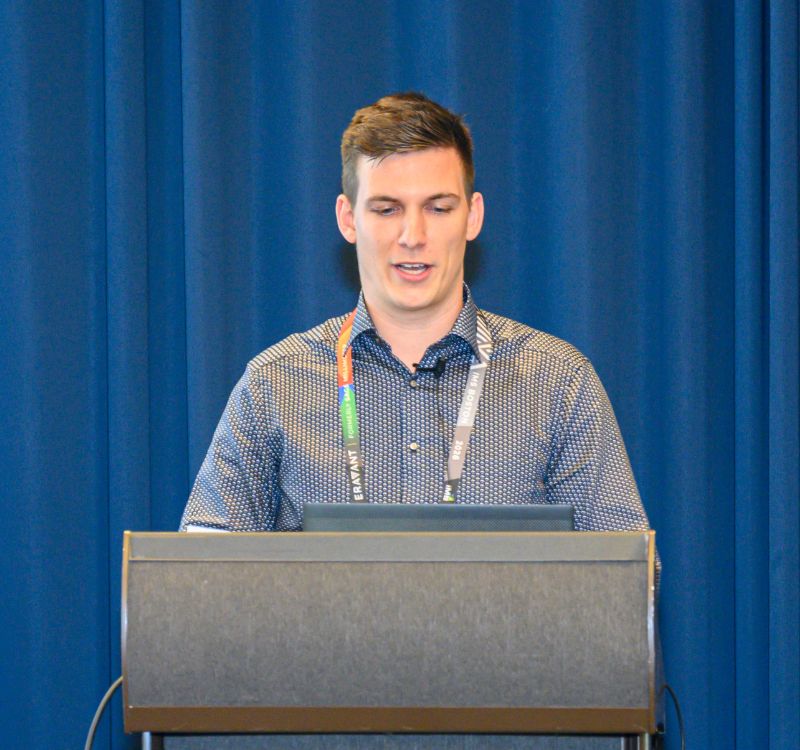
James Skinner (NPL), with Flann Microwave, evaluated the miniature FSM-45 waveguide flange against the IEEE 1785-2a reference in the WR-6.5 band. At a 12 mm outer diameter it matches or exceeds 1785-2a on connection repeatability and interface reflection. The reduced surface area raises contact pressure by about 60% for the same clamping force, and inner dowels alone govern alignment. At some frequencies its connection repeatability reaches the system noise floor, where a reconnection is indistinguishable from random measurement noise.

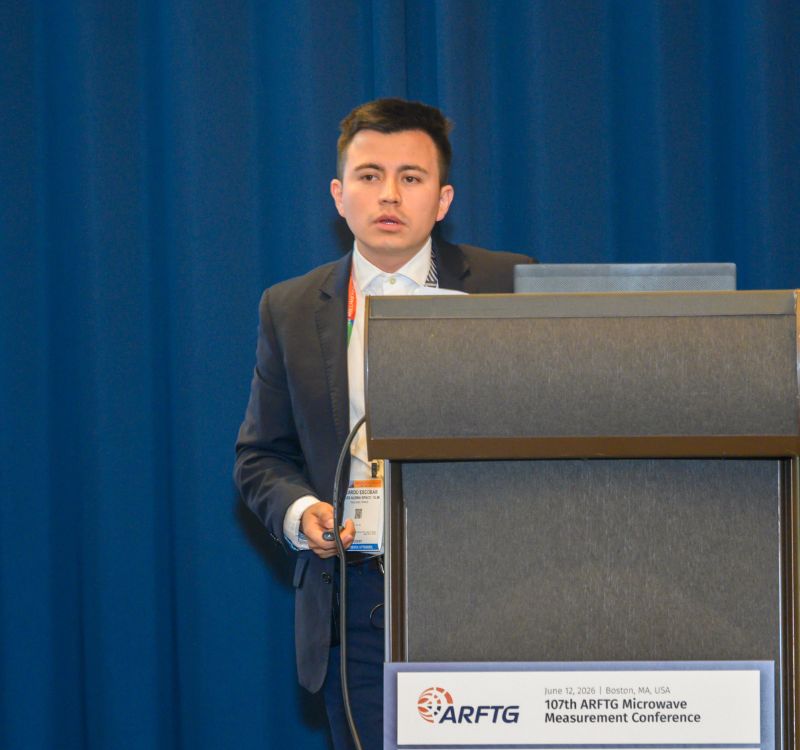
Wideband NPR Characterization of a Ka-Band Power Amplifier Using a Single ‘Multi-Notch’ Stimulus (C3) Ricardo Escobar (Thales Alenia Space), Tibault Reveyrand (XLIM), Sébastien Mons (XLIM), Denis Barataud (XLIM), and Jean-François Villemazet (Thales Alenia Space)

Wideband NPR no longer needs a notch-by-notch frequency sweep.

Ricardo Escobar (Thales Alenia Space) and co-authors replace successively swept single-notch NPR with a single multi-notch stimulus that reads several frequencies per acquisition. On a 4 W Ka-band Class-AB HPA, the multi-notch result tracks the swept reference to within 0.3 dB on average over a 3 GHz bandwidth. Measurement time drops about fivefold. That speed is what makes NPR usable inside iterative HPA tuning.

Analysis of Multiline Calibration Algorithms for Various Transmission Line Types up to 220 GHz” (D1) Gregor Streitenberger (PTB), Gia Ngoc Phung (PTB), Ahmed Sayegh (PTB), Tianze Li (Cornell University), and James C. M. Hwang (Cornell University)

The TUG multiline TRL stays robust even when the line lengths are not optimal for the band.

Gregor Streitenberger (PTB) and co-authors compare the TUG and NIST mTRL algorithms on GCPW and microstrip lines with probes from different vendors, checked against EM simulation from 1 to 220 GHz. When one fixed broadband cal kit is reused across sub-bands, the TUG method keeps its accuracy for both single-sweep and banded measurements. The NIST implementation is more sensitive to non-optimal line lengths in those sub-bands. This makes TUG mTRL a dependable choice for broadband on-wafer calibration up to 220 GHz.

BEST STUDENT PAPER

STUDENTInter-Laboratory Benchmarking of Continuous-Band 220 GHz S-Parameter Measurements of Millimeter-Wave GaN HEMT (D2) Thomas Bonnen (Michigan State University), Rob Jones (NIST), Jerome Cheron (NIST), Benjamin Jamroz (NIST), and Nicholas Miller (Michigan State University)

Continuous-band GaN HEMT measurements are reproducible across labs, until crosstalk caps the calibration’s validity.

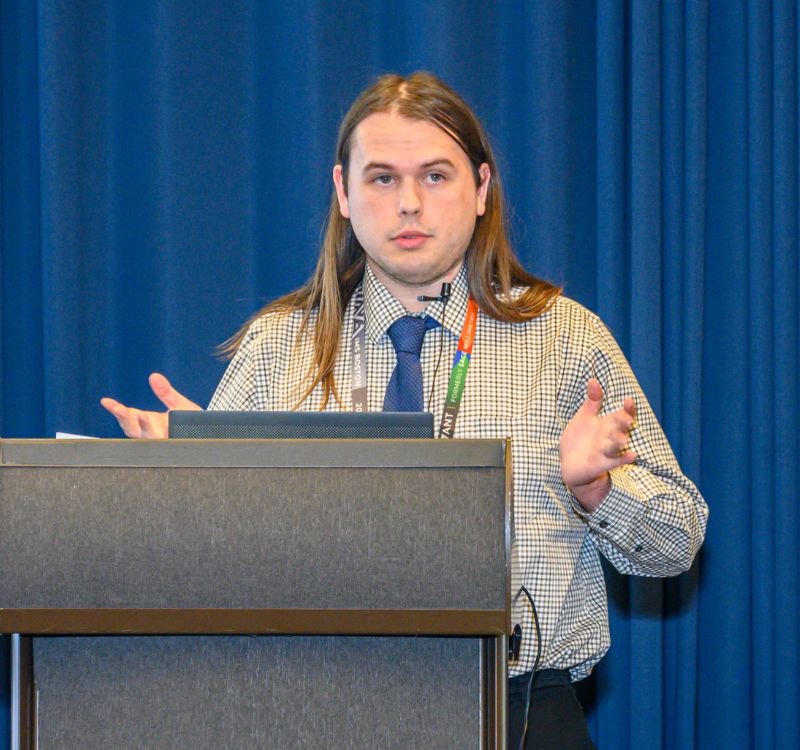
Thomas Bonnen (Michigan State University) and colleagues measured the same 4×50 µm GaN HEMT on independent DC-to-220 GHz single-sweep systems at MSU and NIST, each calibrated with on-wafer mTRL. S-parameters and maximum available gain agree up to 175 GHz, with a worst-case S21 difference of 1.14 dB. Above 175 GHz the calibration fails, as probe-to-probe crosstalk overtakes the device isolation. That fixes a concrete reproducibility bound for continuous-band active-device measurement past 100 GHz.

STUDENTExtracting Graphene Sheet Resistance in the WR-5 Band Using Graphene Embedded CPW Shunt Structures on High-Resistivity Silicon (D4) Zhuoya Zhou (University of Manchester), Zirui Zhang (University of Manchester), Liam Ausden (NPL), Xiaobang Shang (NPL), Yu-Wei Kang (University of Manchester), Guangda Dai (University of Manchester), and Zhirun Hu (University of Manchester)

CVD graphene sheet resistance can be extracted reliably at WR-5 frequencies

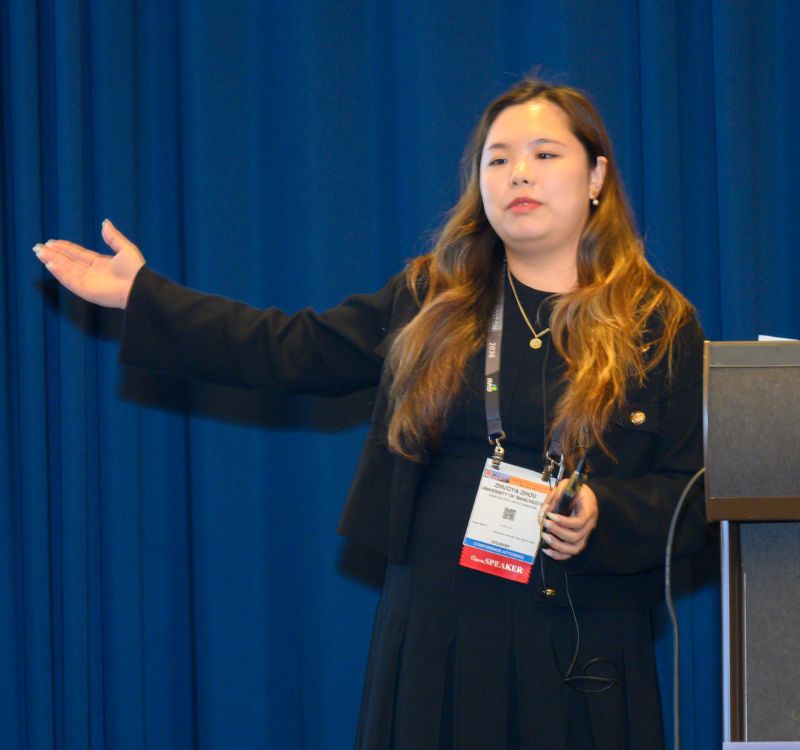
Zhuoya Zhou (University of Manchester) and co-authors embed CVD graphene as shunt patches in CPW on high-resistivity silicon and extract its sheet resistance in the WR-5 band. The value is about 640 Ω/sq with under 10% variation from 140 to 220 GHz, so kinetic inductance and skin effect are negligible. The contact impedance stays more than an order of magnitude below the graphene resistance, and the 50 µm and 100 µm patches agree.

BEST INTERACTIVE FORUM PAPER

EM Assisted Open-Short De-embedding Technique for 16nm FinFET Technology (P1) Ciro Esposito, Federico D’Aniello, Gianni Bosi, Lorenzo Stevenazzi, Andrea Baschirotto, and Valeria Vadalà (University of Milano-Bicocca)

In 16 nm FinFET, a physical Short cannot remove the Source parasitic, so EM simulation supplies it.

Ciro Esposito (University of Milano-Bicocca) and co-authors show that 16 nm FinFET routing rules make the Short standard’s source path physically non-ideal, which corrupts Open-Short de-embedding. They build only the layout-robust portion of the Short and take the dominant source impedance from EM simulation, then subtract it analytically. The de-embedded S-parameters stay physically consistent from 1 to 125 GHz.

Dielectric Waveguide-Based Test Probes for Millimeter-Wave Range Test and Measurement Instrumentation (P4) Guillermo Carpintero-Del-Barrio (Universidad Carlos III de Madrid), Ashish Kumar (Universidad Carlos III de Madrid), Sergio Rivera (Universidad Carlos III de Madrid), Jiale Tian (Universidad Carlos III de Madrid), Luis Gonzalez Guerrero (Universidad Carlos III de Madrid), Muhsin Ali (Leapwave Technologies), Daniel Gallego Cabo (Leapwave Technologies), and Alejandro Rivera Lavado (Leapwave Technologies)

A dielectric-waveguide probe couples to the wafer with no physical contact and stays under 1 dB loss to 110 GHz.

Guillermo Carpintero-del-Barrio (Universidad Carlos III de Madrid) and co-authors couple a coplanar antenna into a silicon dielectric waveguide to build a contactless RF probe based on near-field coupling. A 40 µm gap keeps transmission loss under 1 dB up to 110 GHz, with positioning tolerance of ±40 µm vertically and ±100 µm laterally. A quartz multiple-short (mSSS) kit calibrates it without needing a matched load. This points toward continuous millimeter-wave to terahertz probing.

BEST INTERACTIVE FORUM PAPER

Keysight Technologies, USA

keysight.com

Congratulations to all ARFTG-107 award winners!

ARFTG Luncheon

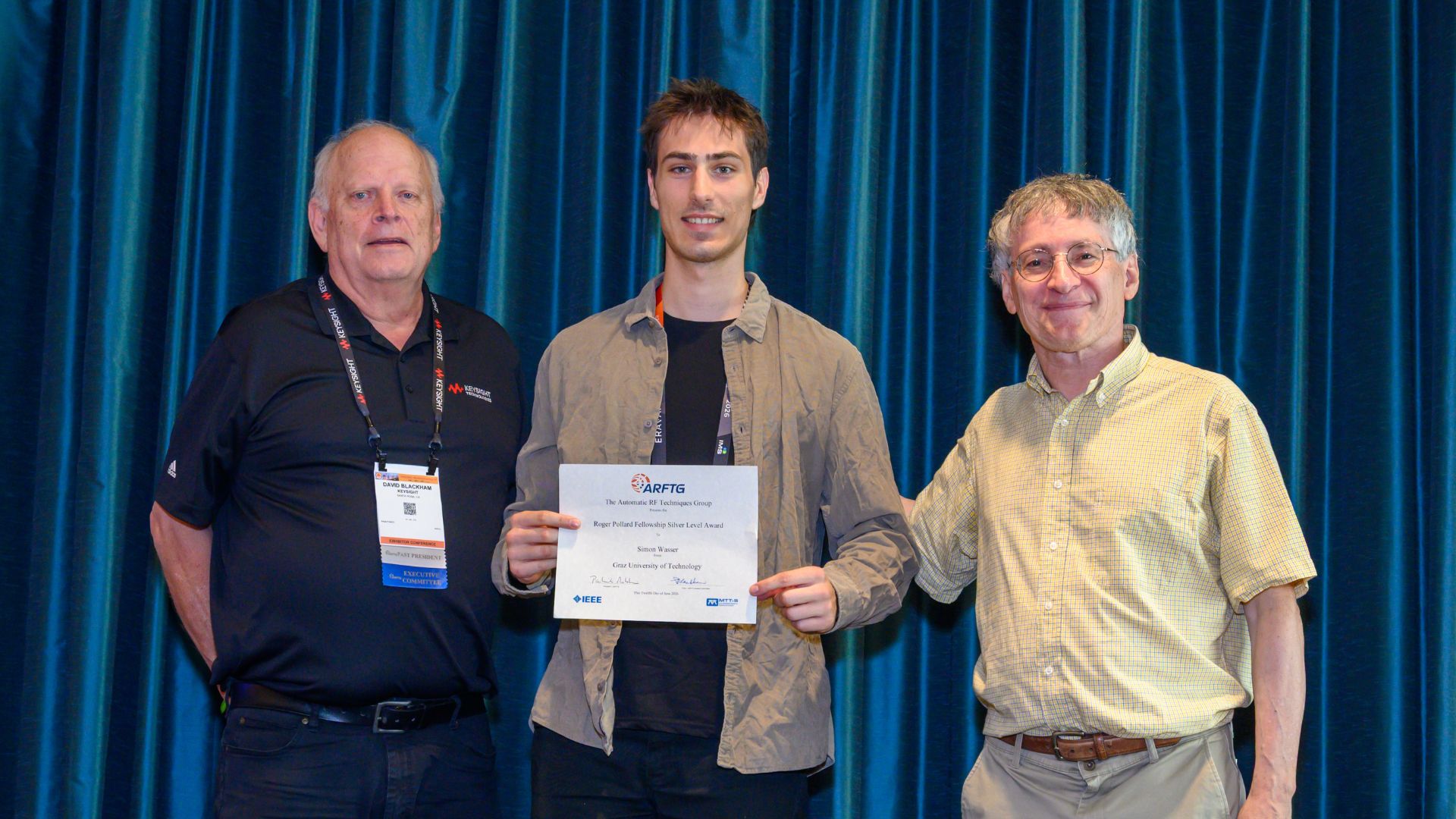
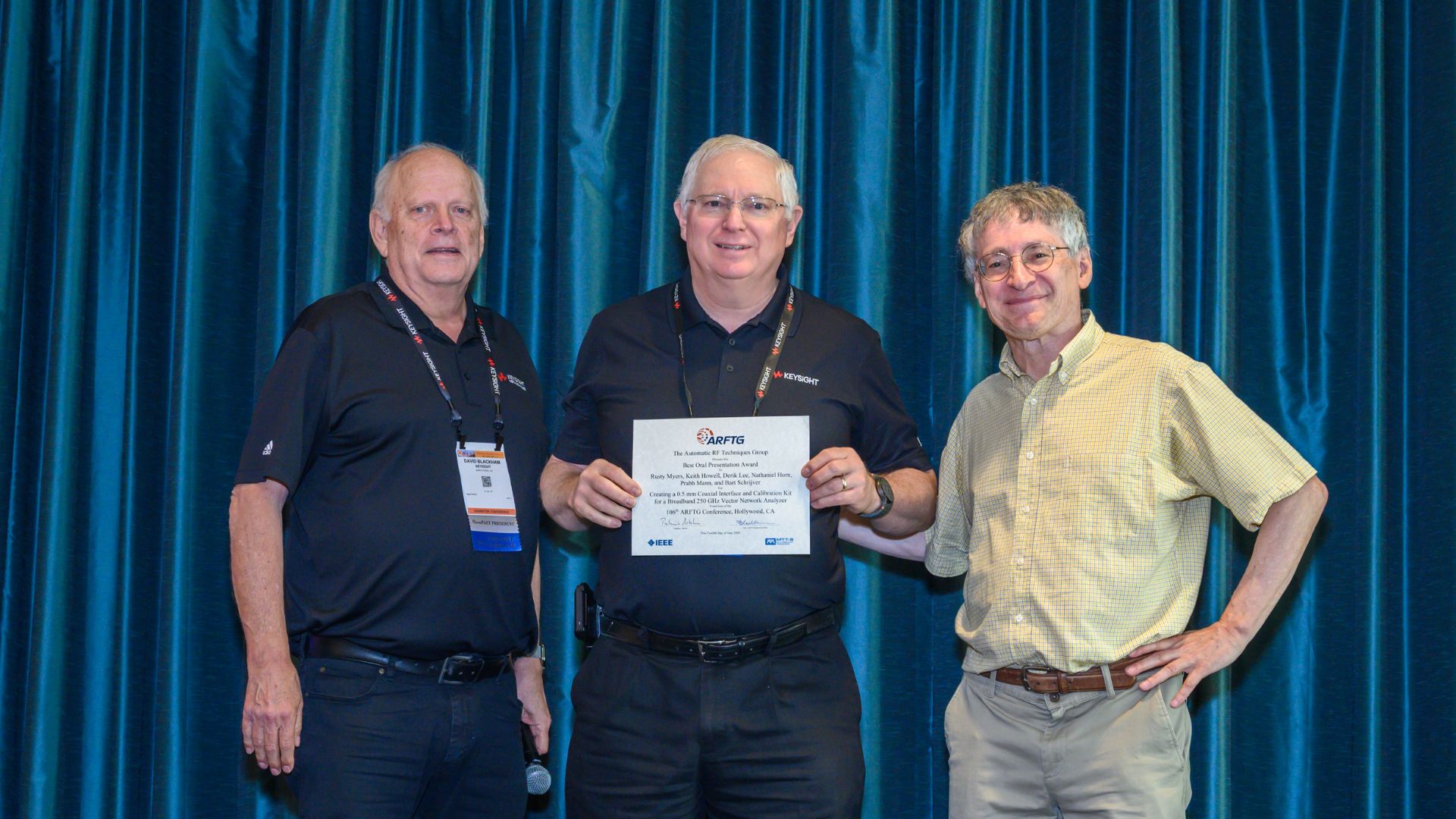
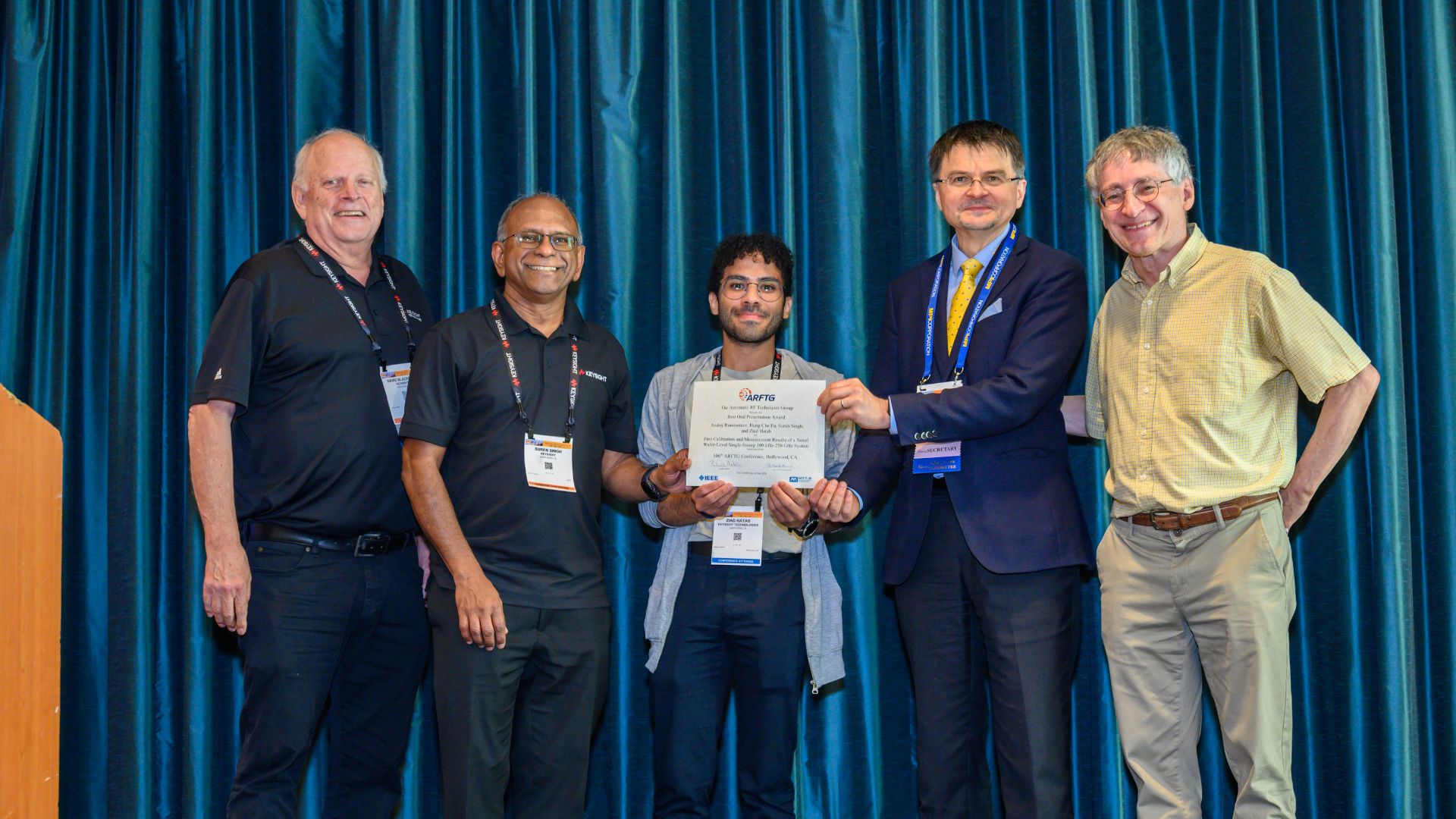
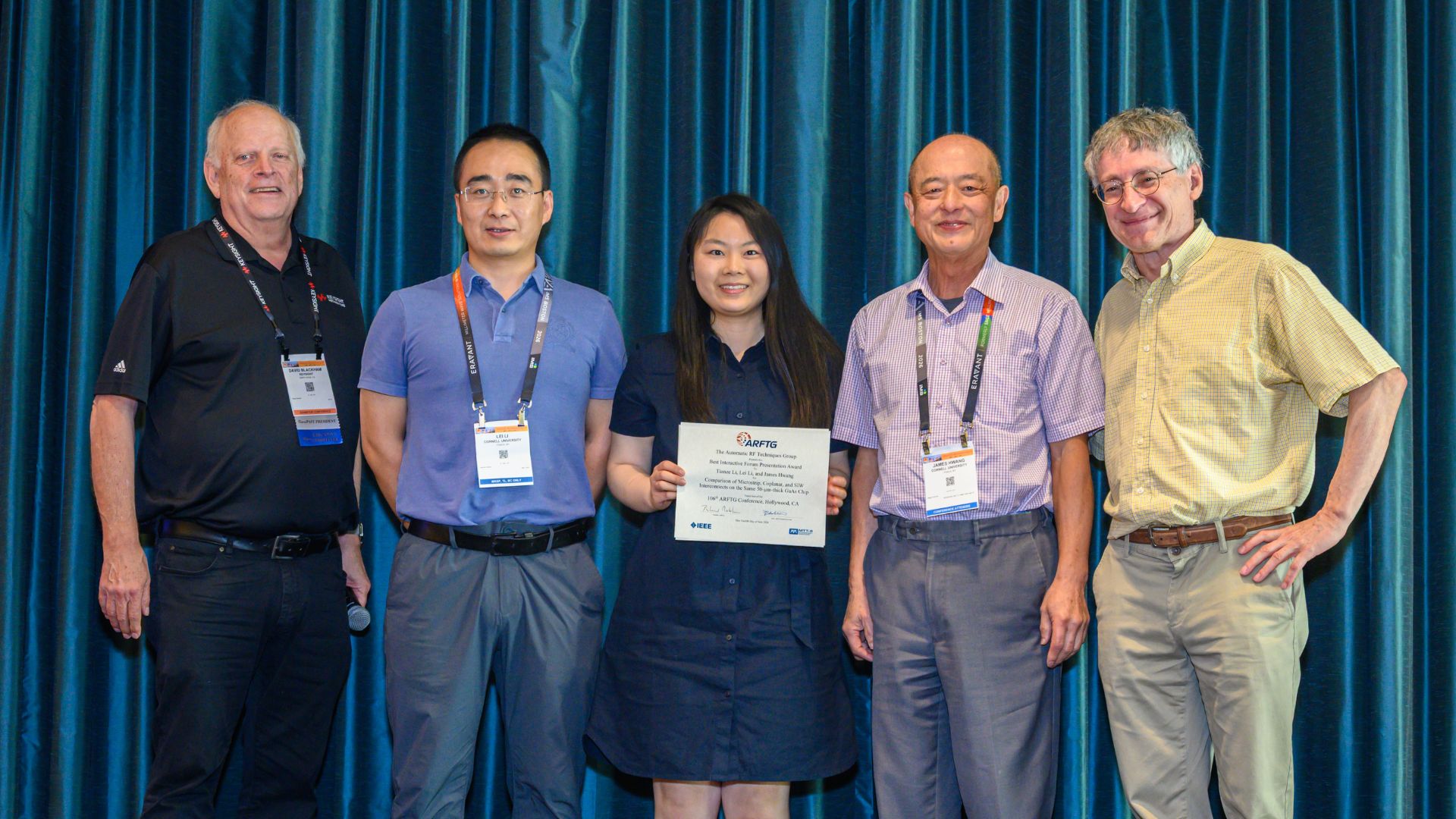
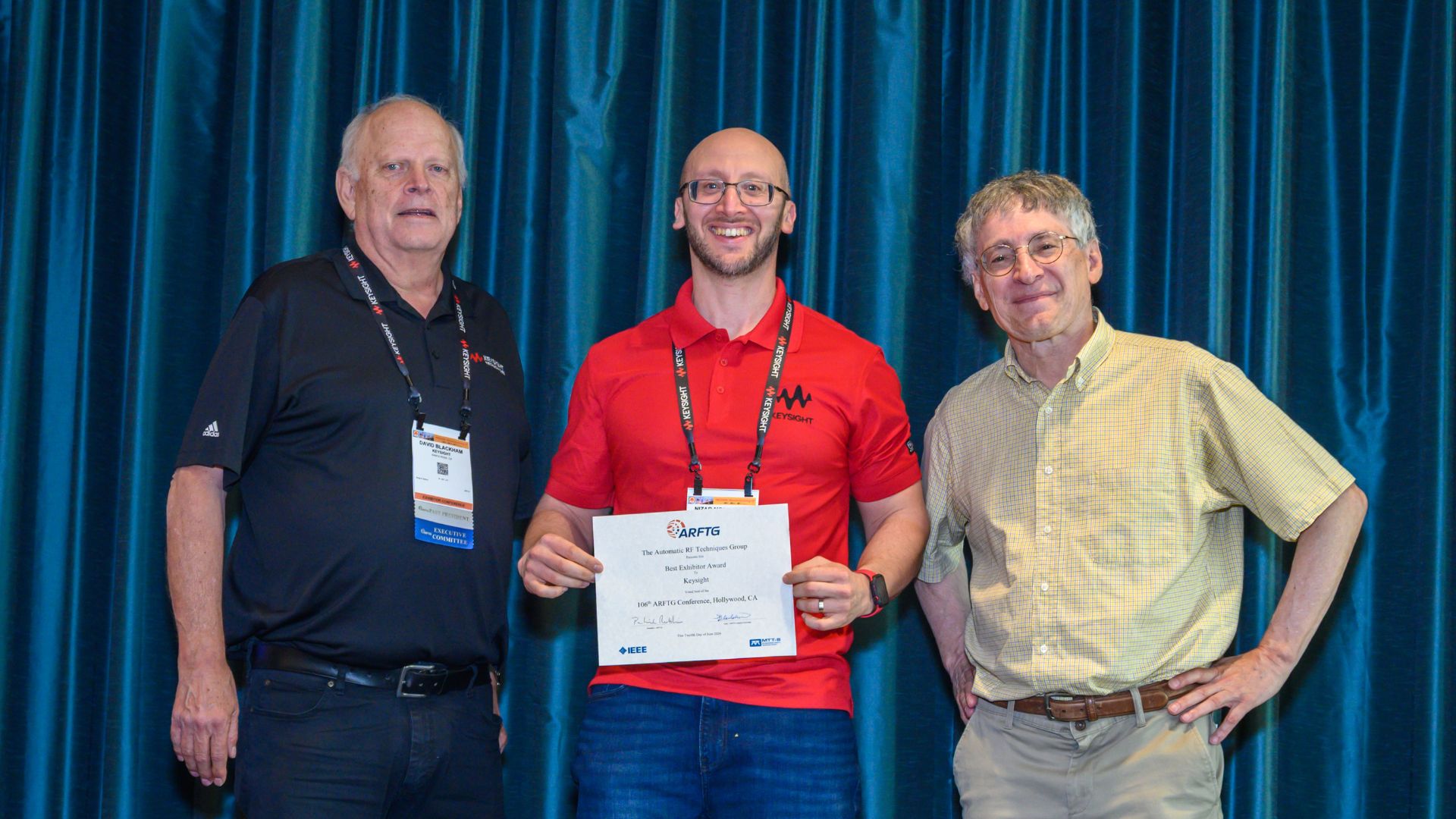
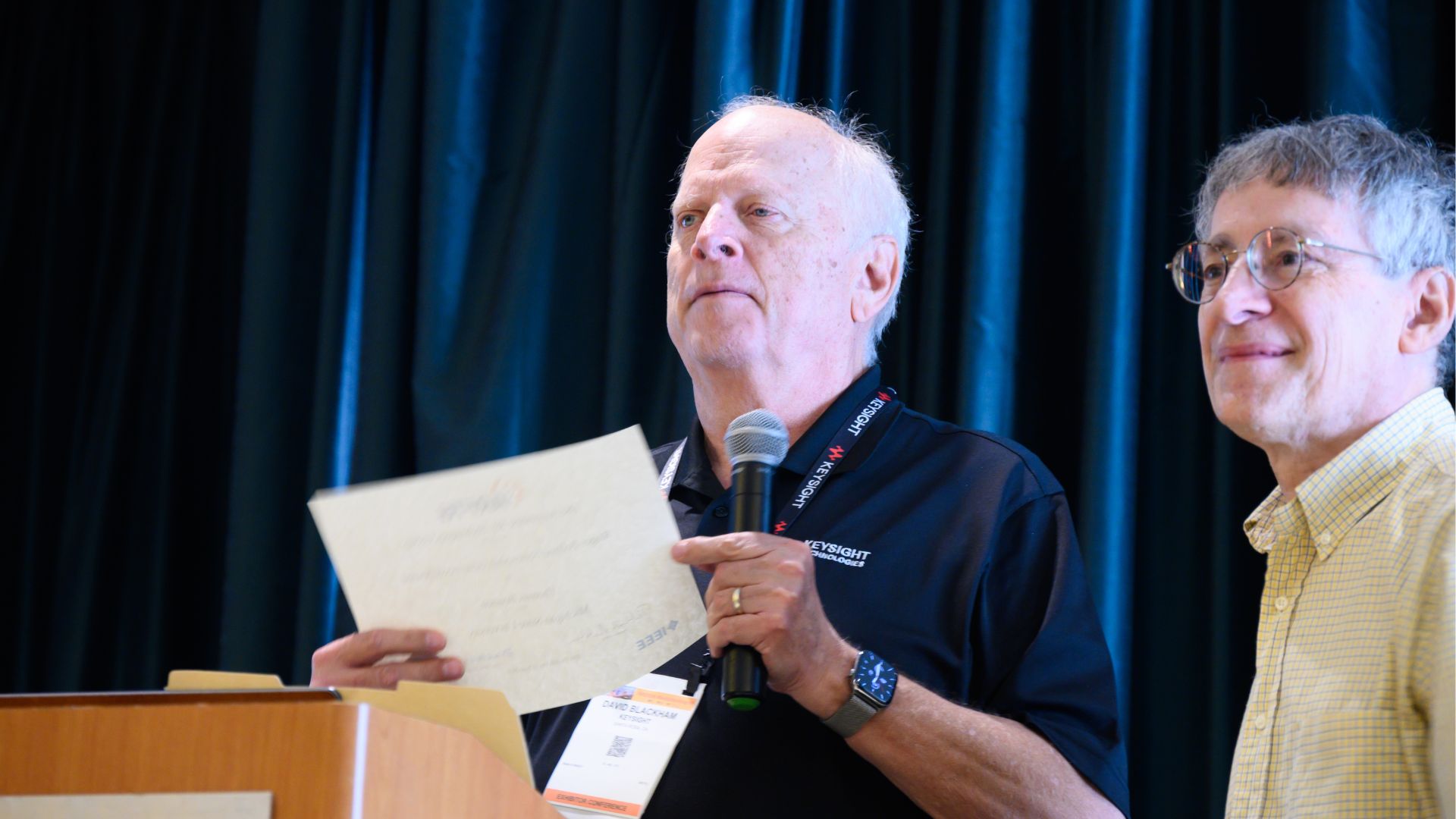
The Awards Luncheon is held at every ARFTG conference; it is where the previous edition’s awards are formally presented. In Boston, ARFTG President Patrick Roblin and Awards Chair Dave Blackham presented the 106th ARFTG Conference Awards.

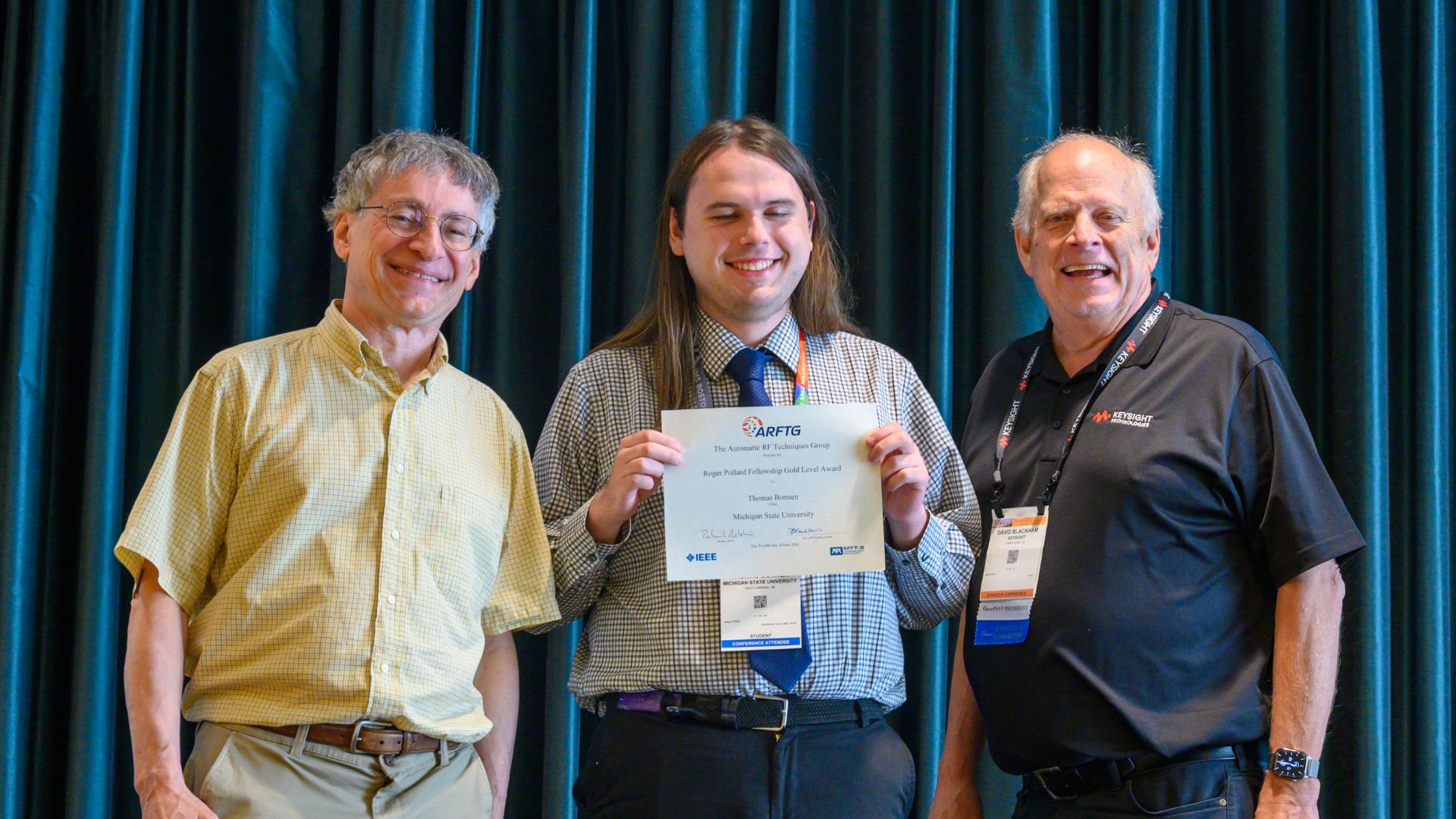
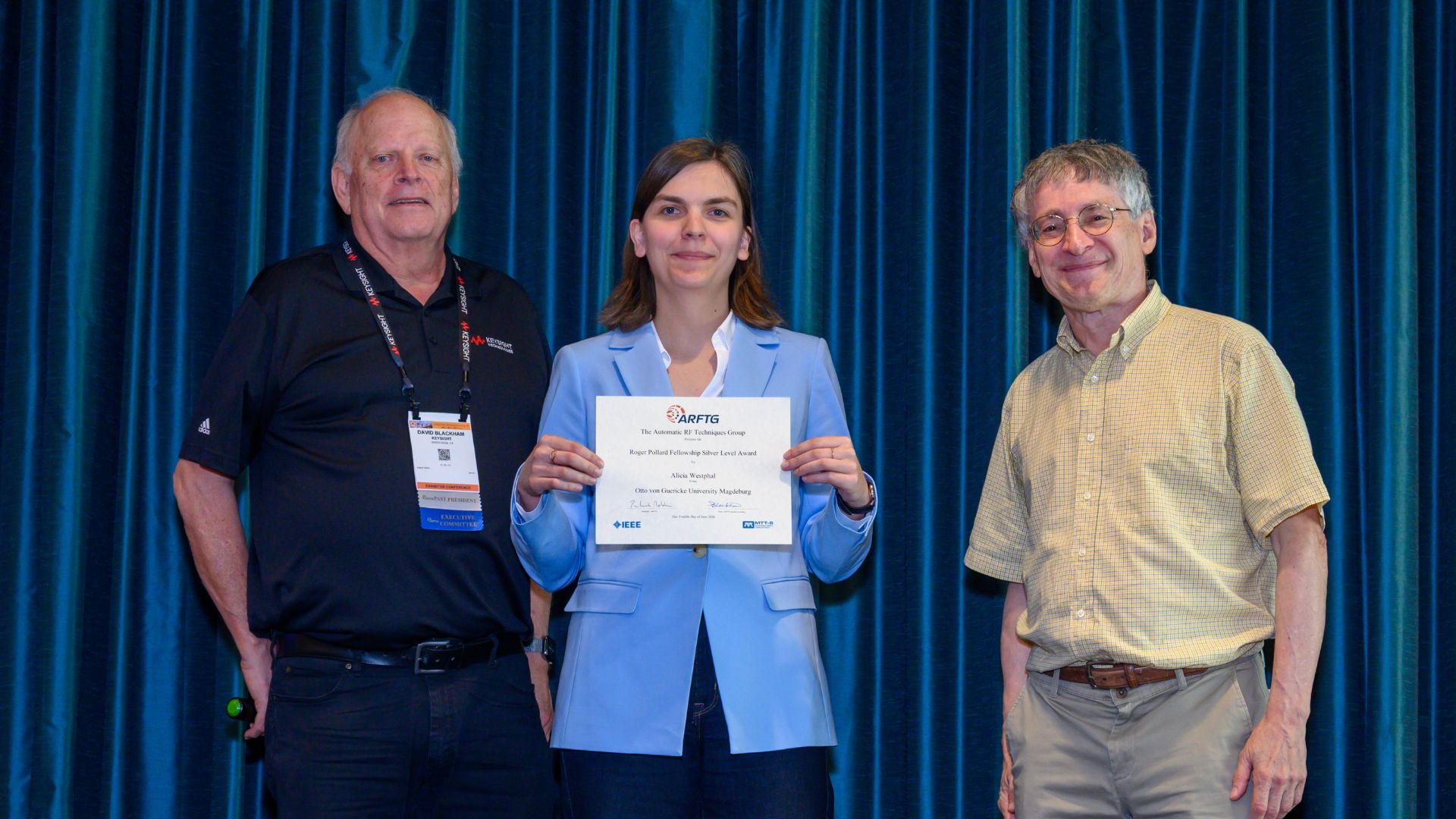
The luncheon also honored this year’s Roger Pollard Fellowship Award recipients:

  • Thomas Bonnen (Michigan State University, Gold),
  • Simon Wasser (Graz University of Technology, Silver), and
  • Alicia Westphal (Otto-von-Guericke-Universität Magdeburg, Silver).

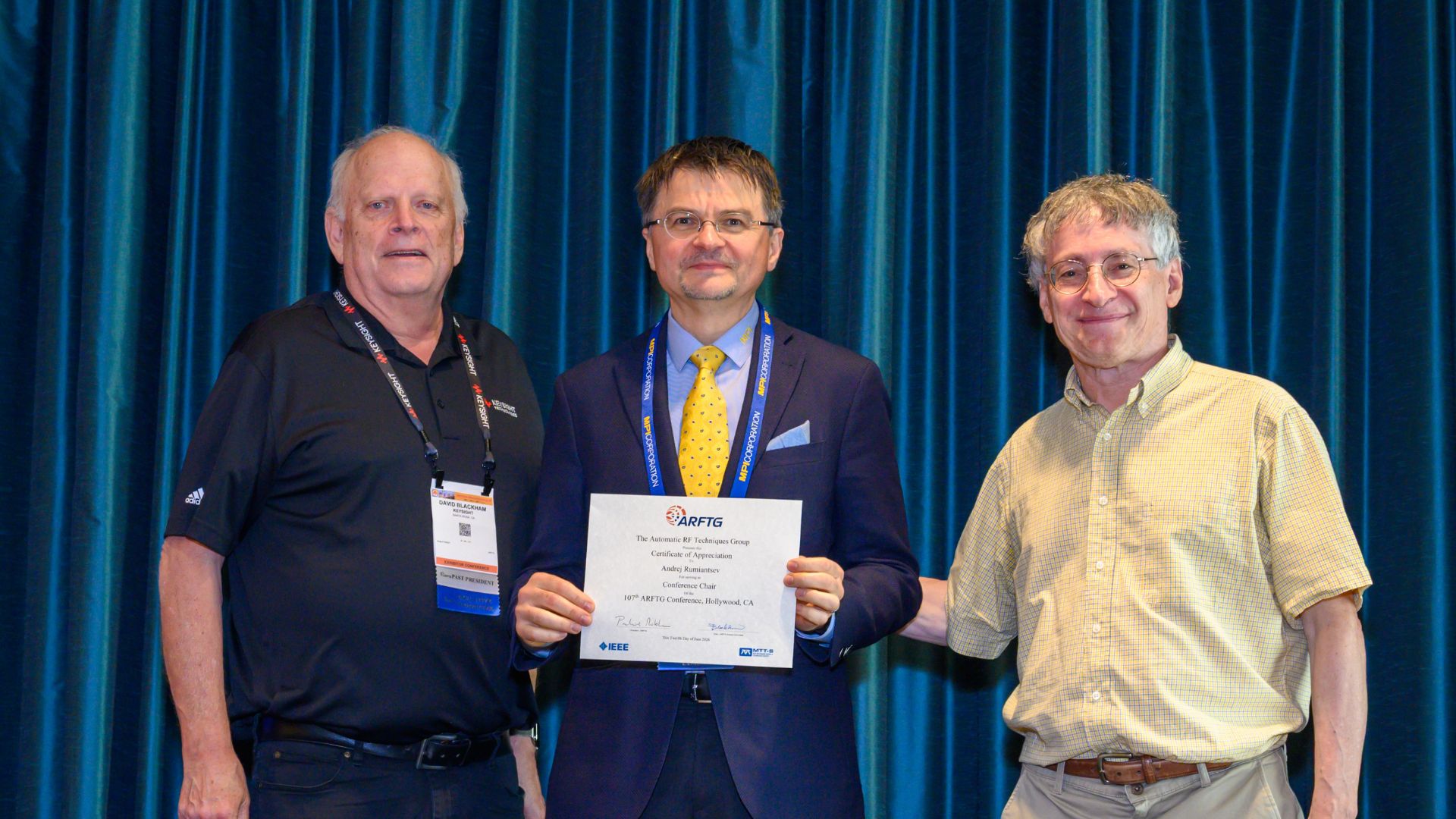
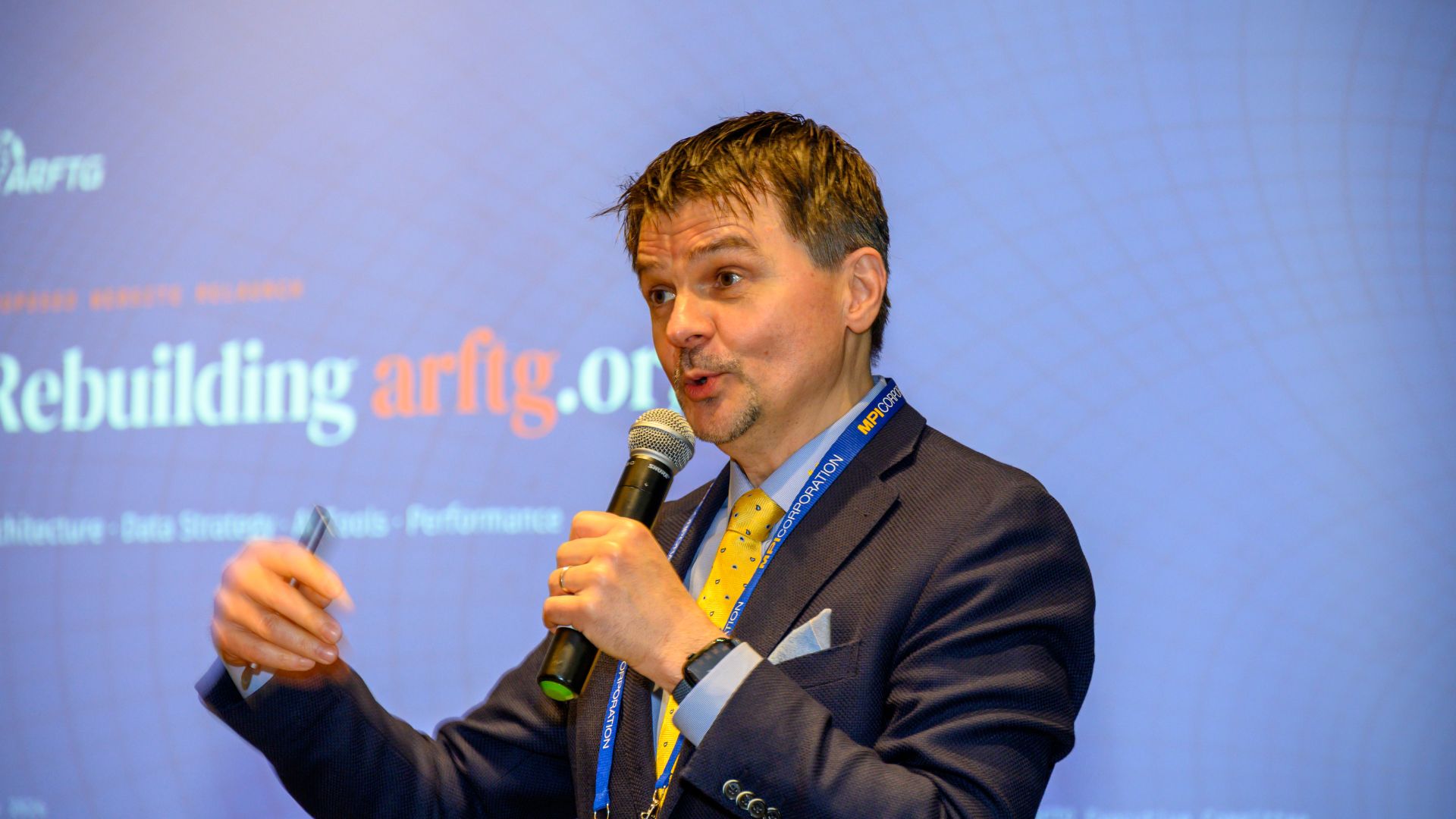
The luncheon agenda closed with General Chair Andrej Rumiantsev presenting the ongoing project to rebuild the next-generation ARFTG website.
On the exhitbit floor

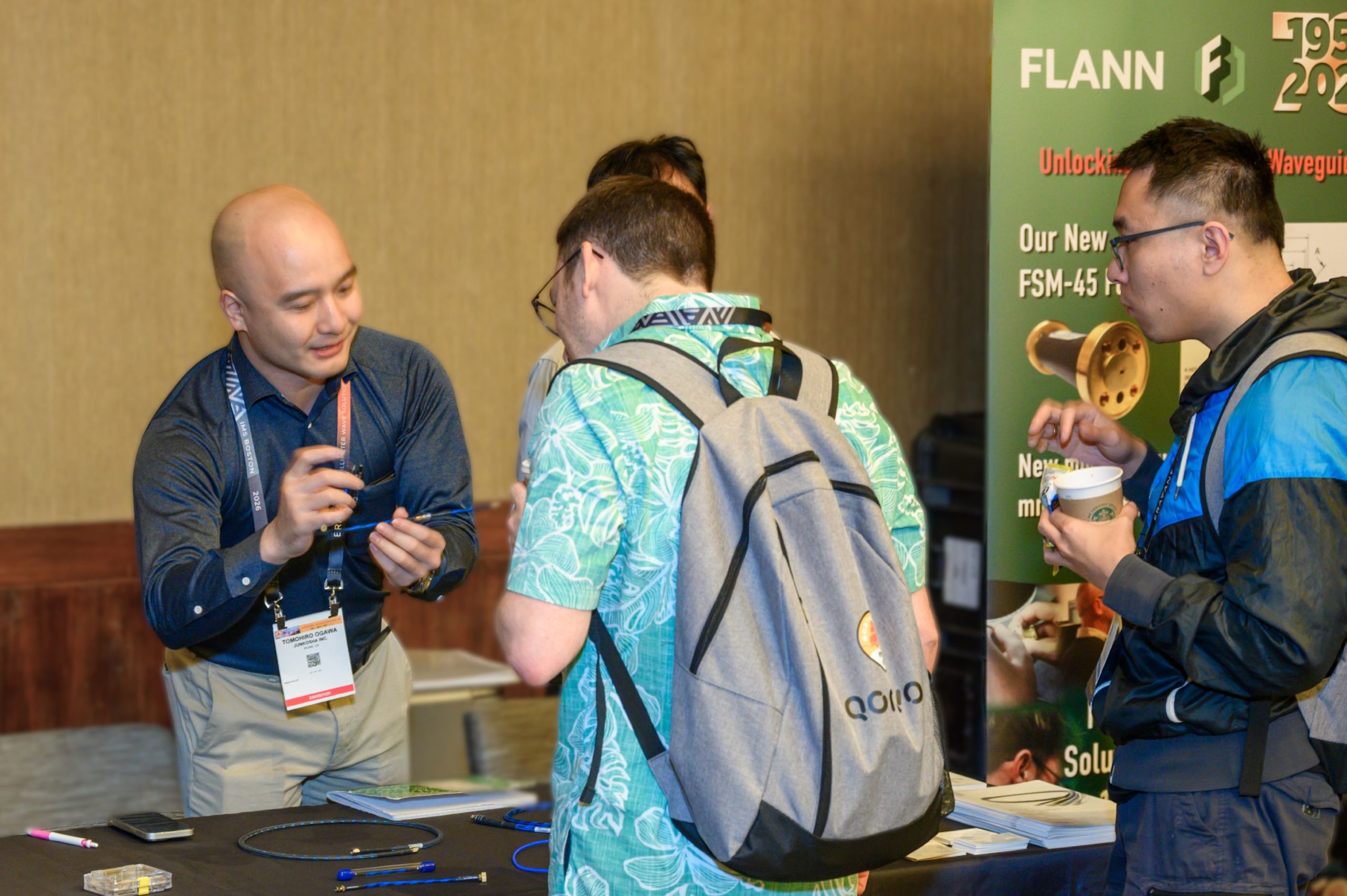
Thirteen companies exhibited alongside the technical program, running fifteen tables across the two exhibit breaks:
01AnritsuUSA
02Copper MountainUSA
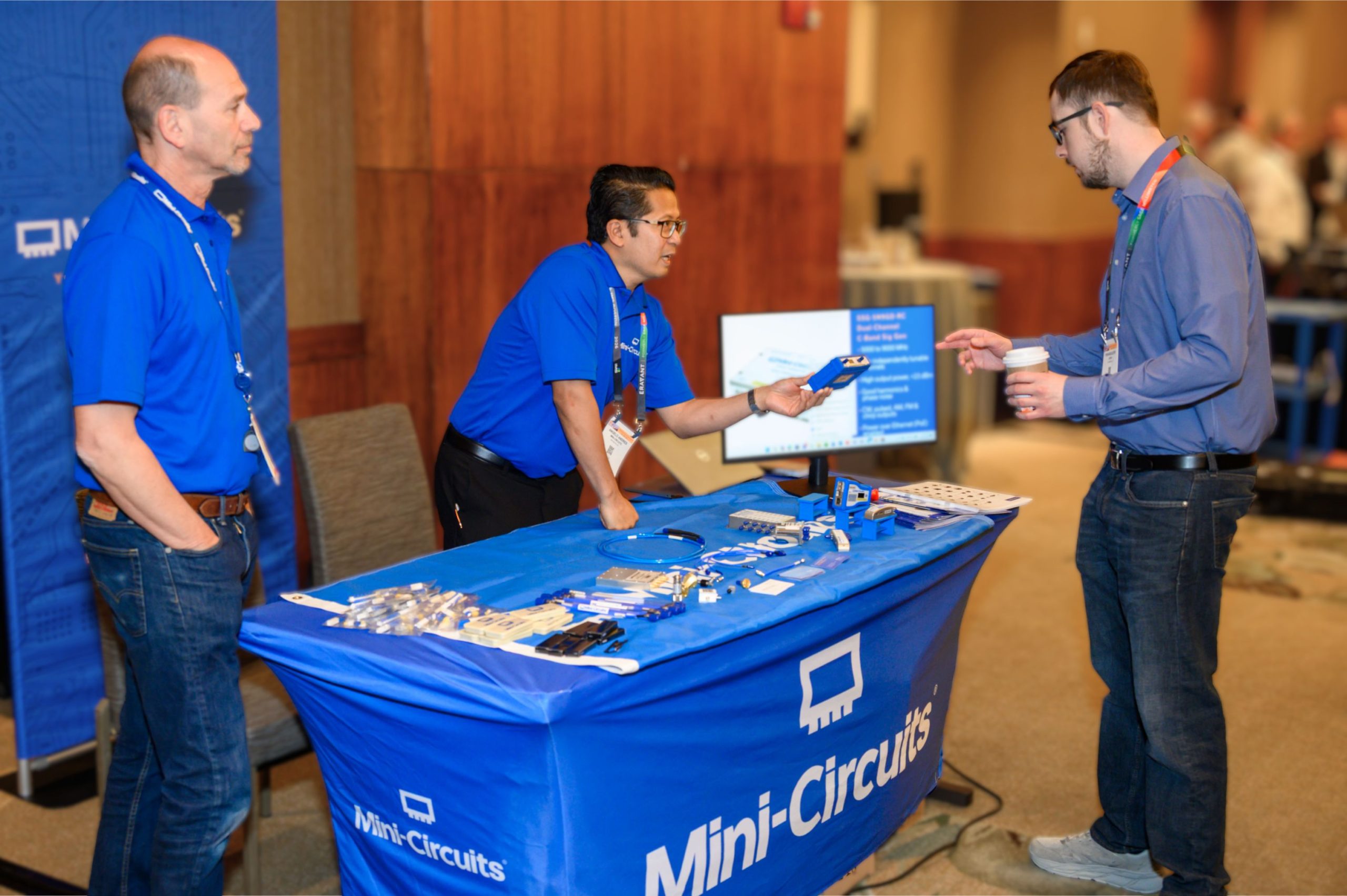
Attendees visit the Mini-Circuits exhibit during the ARFTG-107 exhibit break.
03EravantUSA
04Flann MicrowaveUSA
05FormFactorUSA
06JunkoshaUSA
Best ExhibitorKeysightUSA
07Mini-CircuitsUSA
Attendees visit the Flann Microwave exhibit during the ARFTG-107 exhibit break.
08MPI & Focus MicrowavesTaiwan / Canada
09Rohde & SchwarzGermany
10SpinnerGermany
11Virginia DiodesUSA

Around the conference

ARFTG’s week in Boston ran wider than the conference day — workshops, standards meetings, the Users Forums, and two ARFTG ExCom Meetings (Pre-Conf: Thursday, June 11; Post-Conf: Friday, June 12) all took place across International Microwave Week.

Full House at the Users’ Forums

Both ARFTG Users Forums ran on Thursday, June 11, each a focused venue for its own measurement community.

The NVNA Users’ Forum, chaired by Patrick Roblin (Ohio State University), focused on nonlinear vector network analysis. Its talks covered W-band vector-calibrated active load-pull measurements and advanced time-domain techniques for nonlinear device measurement, from track-and-hold receivers to pumped diode detectors.

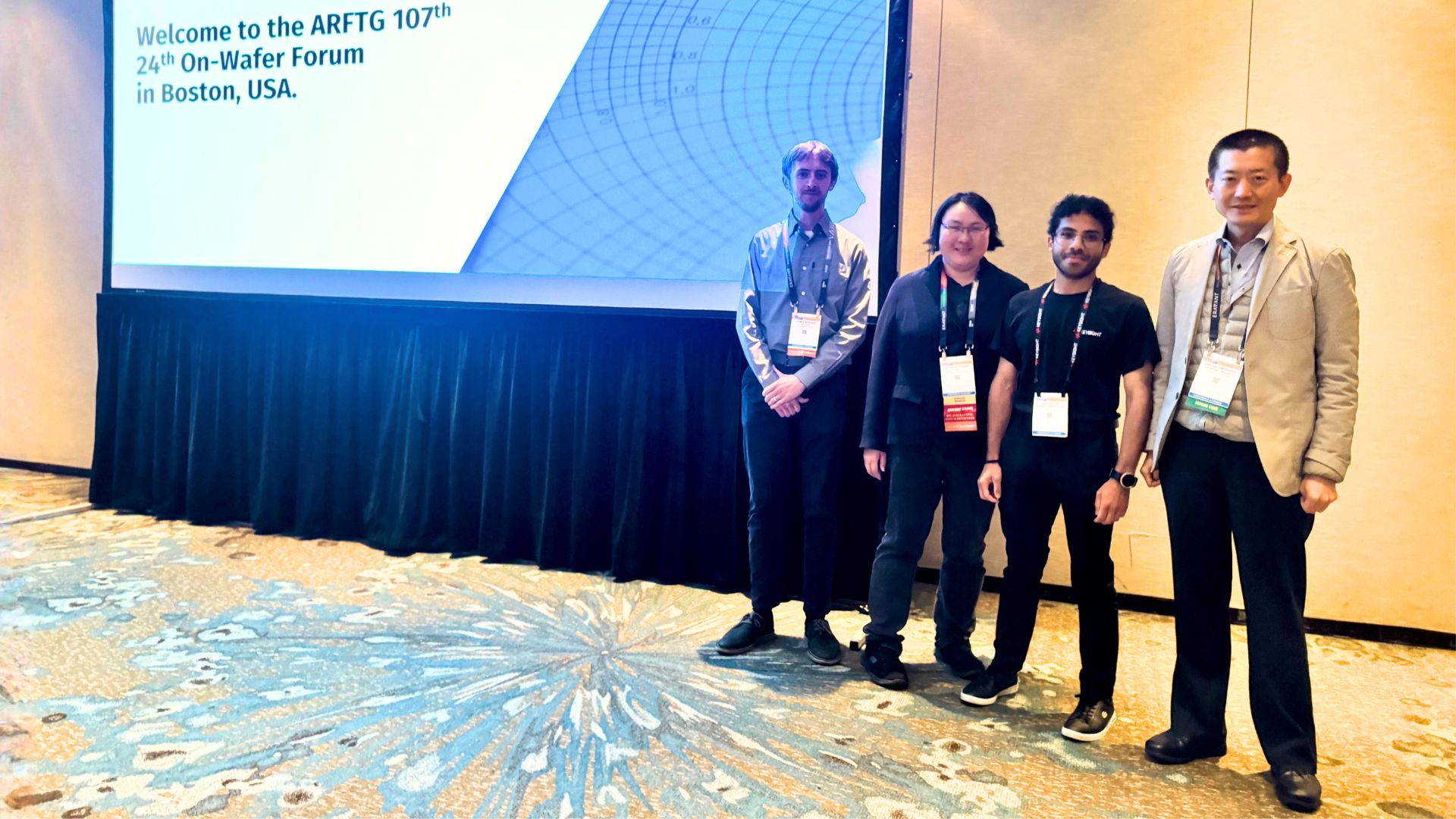
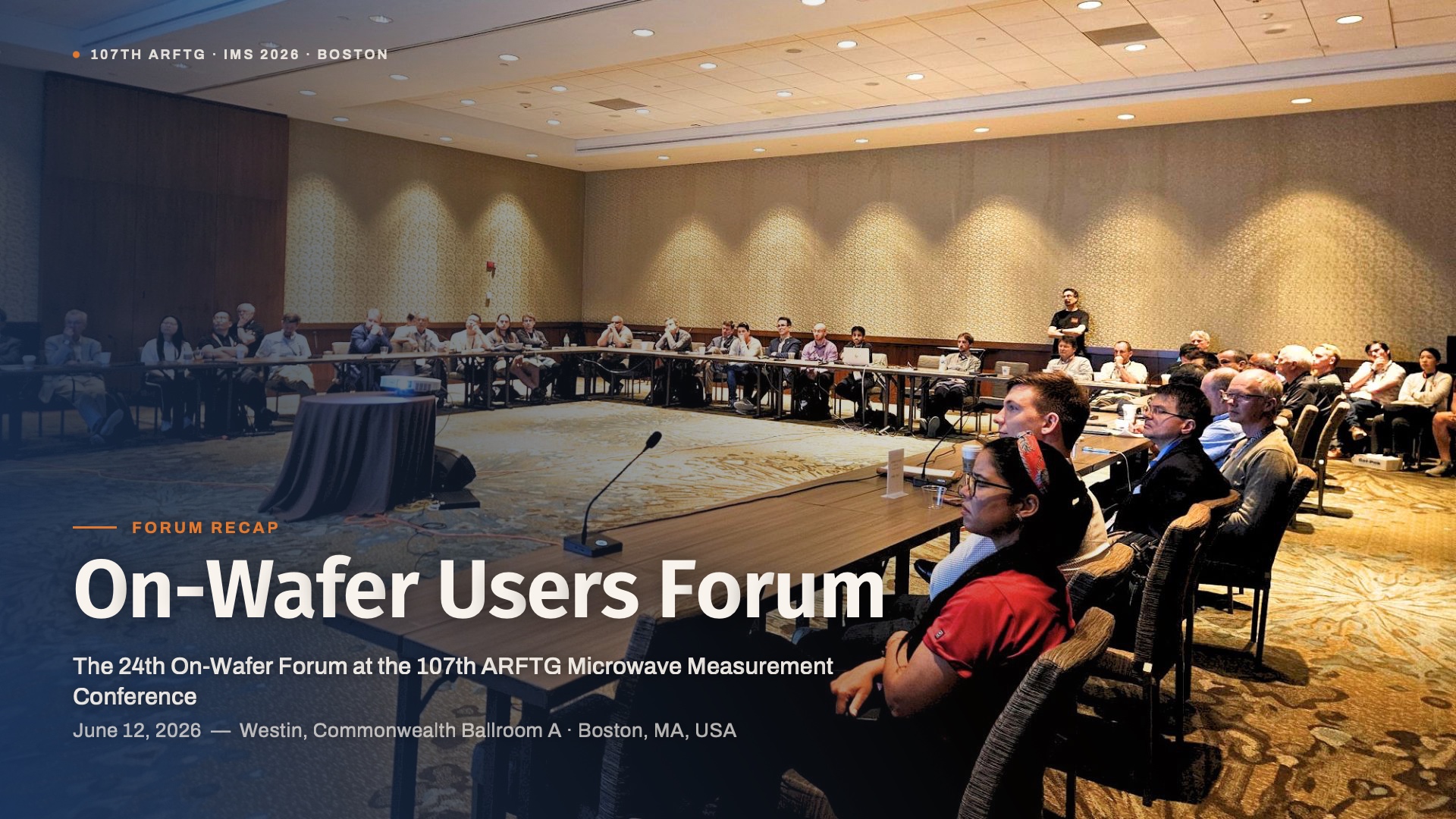
The 24th On-Wafer Users’ Forum was certainly one of the highlights of the week in Boston: chaired by Gia Ngoc Phung (PTB, Germany), it drew 48 participants from industry, metrology institutes, and academia.

It brought together three complementary talks from Ziad Hatab (Keysight Technologies), James Skinner (NPL), and Shuhei Amakawa (Hiroshima University). Together, they traced a single thread from the mathematics of multiline TRL calibration through its implementation to the interpretation of the de-embedded result. The talks sparked a lively discussion among the participants, reflecting the community’s interest in the rigor and reproducibility of wafer-level calibration.
ARFTG/IMS Workshops

ARFTG — together with its IMS partner committees RFSA and RFTT — co-sponsored four workshops across IMS-2026. Topics spanned from wafer-level sub-THz calibration, through phase and over-the-air measurement, to microwave measurements for quantum hardware.

 SUN · JUN 7 · WSI

On-Wafer Sub-THz Measurements: from Fundamentals to Next-Generation Tools and Applications

 MON · JUN 8 · WMK

Unlocking the Power of Phase Information in RF Measurements

 MON · JUN 8 · WML

Bridging from Conductive to Over-the-Air Characterization of Integrated Active Antenna Systems Using Reverberation Techniques

 THU · JUN 11 · WTHA

Microwave Measurements Supporting Quantum Technologies

IEEE Standards Working Group Meetings

ARFTG — together with its IMS partner committees RFSA and RFTT — co-sponsored four workshops across IMS-2026. Topics spanned from wafer-level sub-THz calibration, through phase and over-the-air measurement, to microwave measurements for quantum hardware.

 WED · JUN 10 · IEEEP2822

On-Wafer Calibrations, De-Embedding and Measurements

 THU · JUN 11 · IEEE P3136

Universal Waveguide Interface (≥ 60 GHz)

THU · JUN 11 · IEEE P287.1

Precision Coaxial Connectors

 THU · JUN 11 · IEEE P1785 

Rectangular Waveguides and Their Interfaces (≥ 110 GHz)

Save the Date

Looking ahead: ARFTG-108 takes on space

As I close out this conference, let me point you toward the next one: the 108th ARFTG Microwave Measurement Conference from January 17–20, 2027 in Tampa, FL, co-located with Radio & Wireless Week 2027 and dedicated to the topic:

“Microwave Measurement Challenges for Space and Satellite Systems”

In Tampa, the ARFTG-107 award winners will be formally recognized at the ARFTG-108 Awards Luncheon — so there’s one more reason to be there.

The Call for Papers is now open, with abstracts due September 11, 2026. If your work touches measurement for non-terrestrial communication, space-based sensing, OTA characterization for satellite applications, or testing under space environmental conditions, this is the room where you want to present it.

I wish the whole ARFTG-108 team every success:

  • Conference Chair Mauro Marchetti (Maury Microwave),
  • Conference Co-Chair Chong Li (University of Glasgow),
  • TPC Chair Gian Piero Gibiino (University of Bologna), and
  • TPC Co-Chair Gia Ngoc Phung (PTB).
Save the Date

ARFTG-108

Tampa, FL
January 17–20, 2027

ABSTRACT DUE · SEPTEMBER 11, 2026

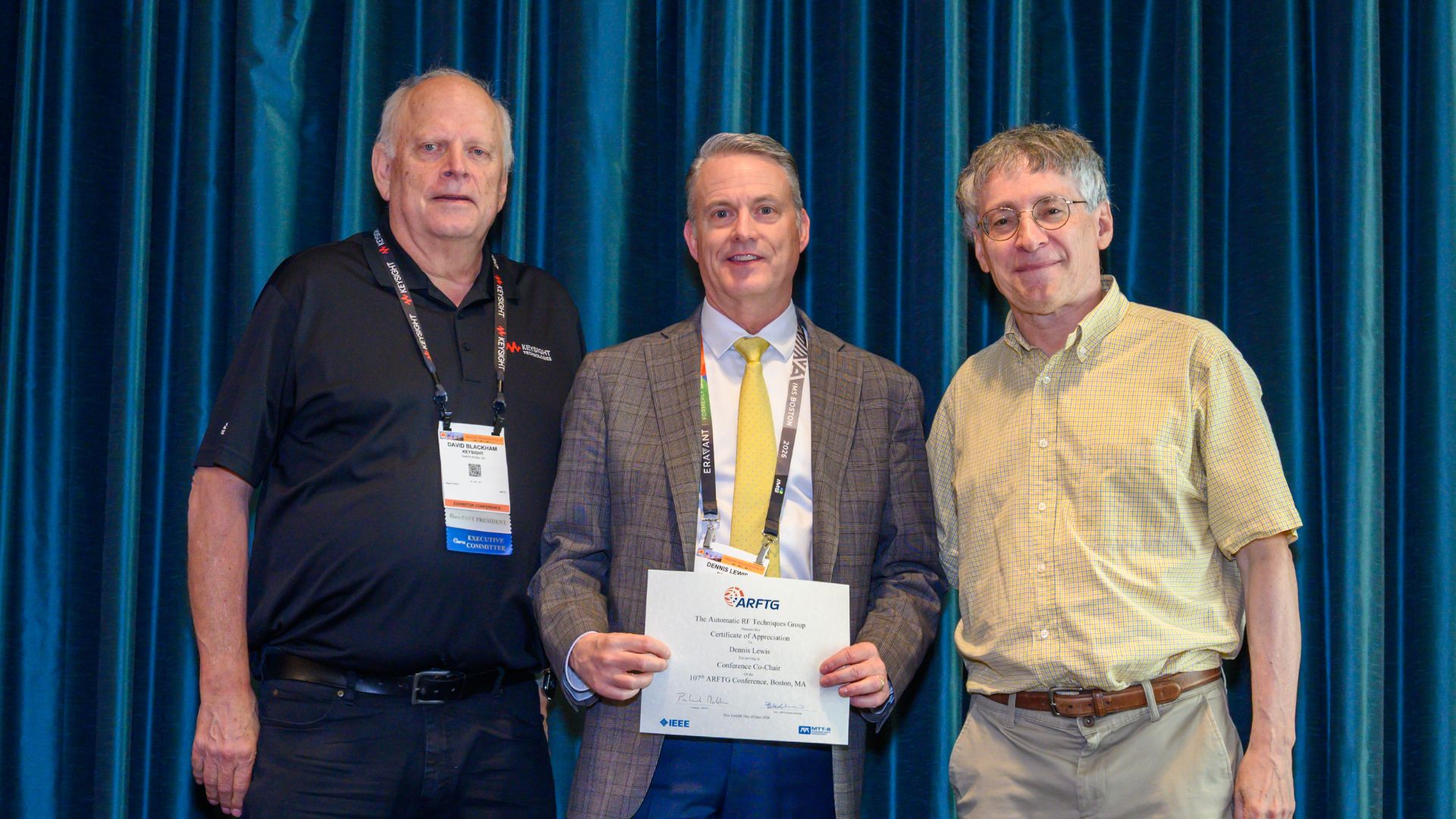
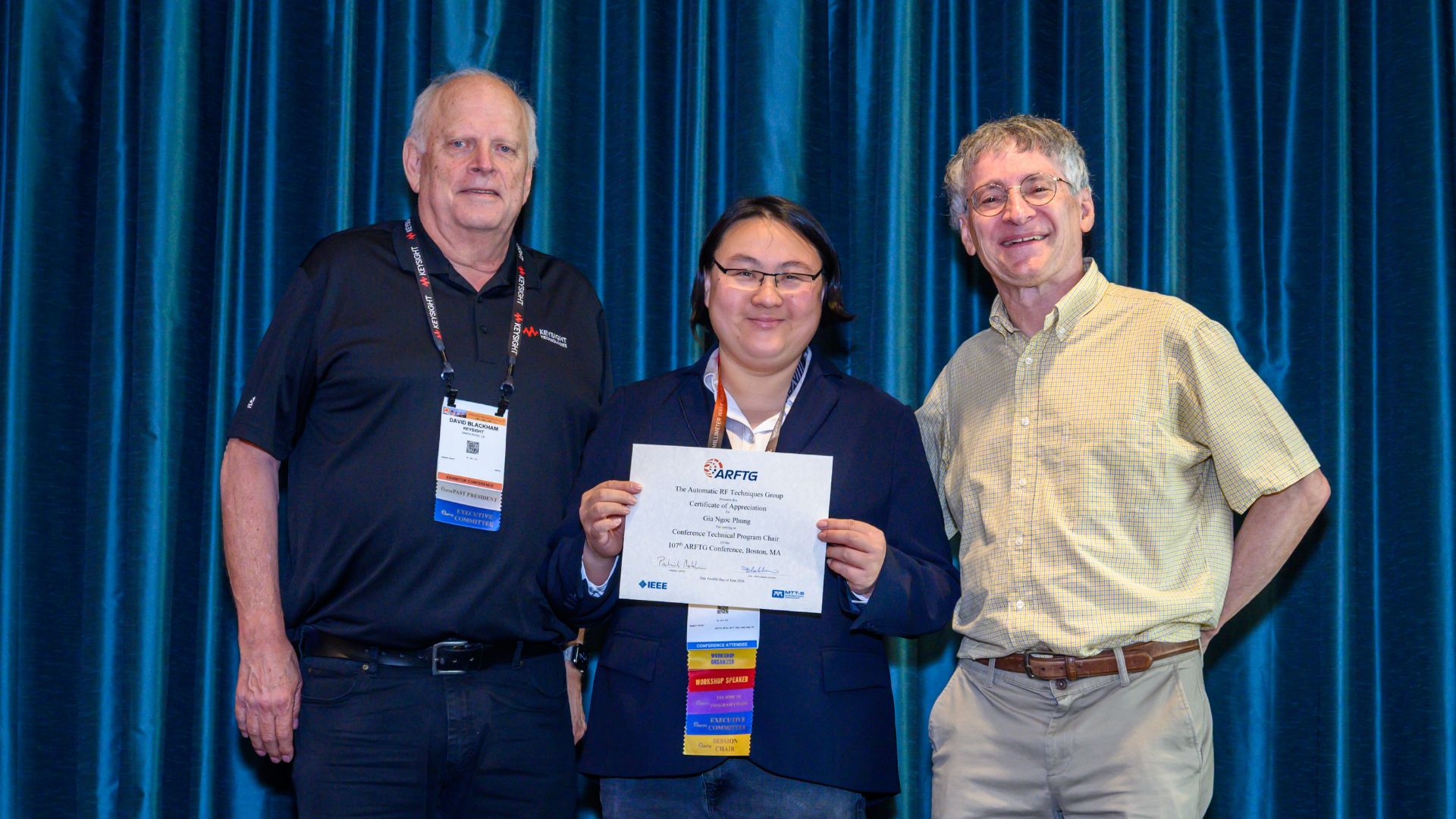
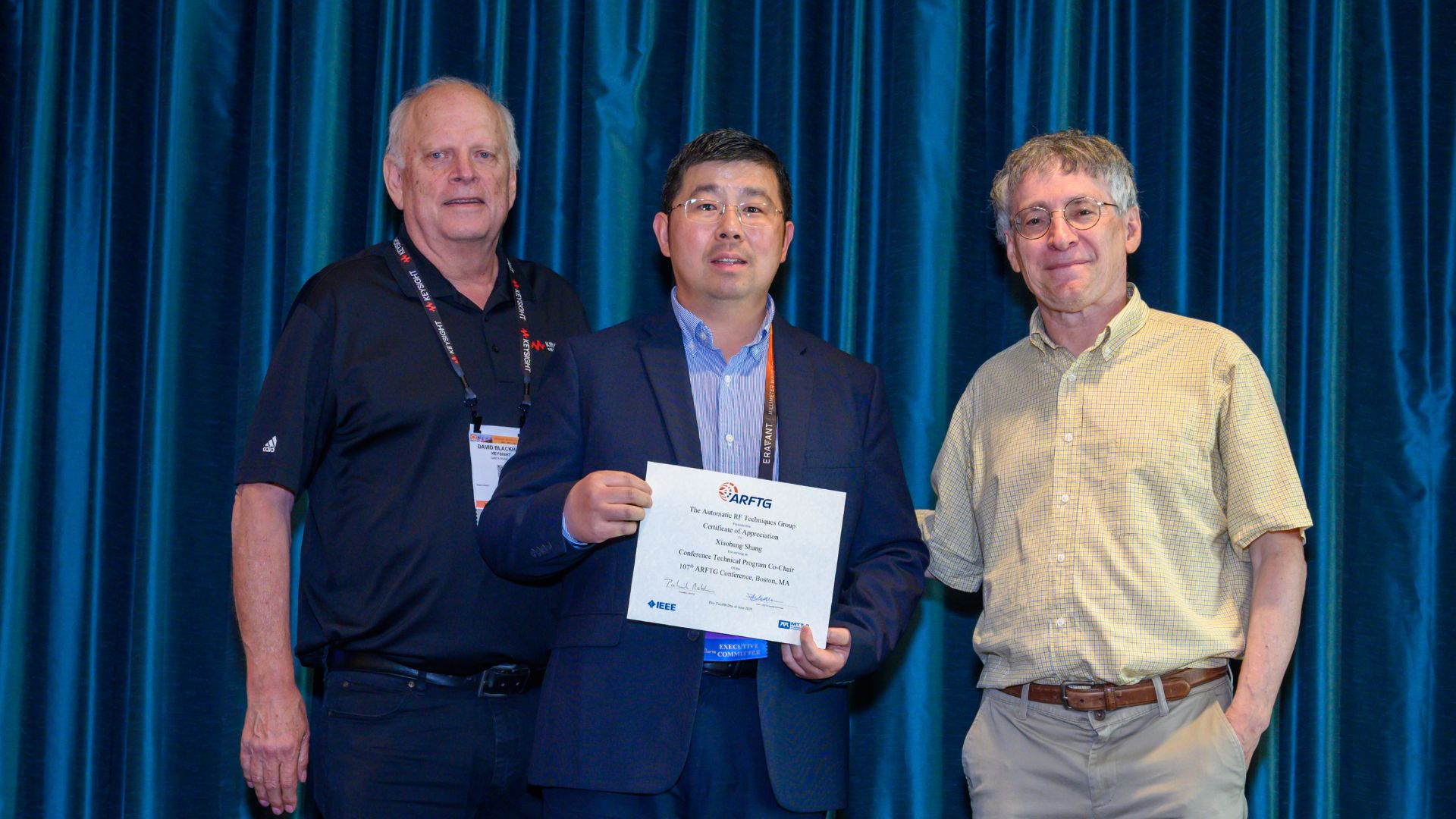
A conference like this is carried by many hands. My thanks go to my co-chairs — General Co-Chair Dennis Lewis (Boeing), Technical Program Co-Chairs Gia Ngoc Phung (PTB) and Xiaobang Shang (NPL) — to the session chairs and reviewers, to our sponsors and exhibitors, and to everyone who presented, voted, and argued about measurements until the room was cleared. See you all again in Tampa!
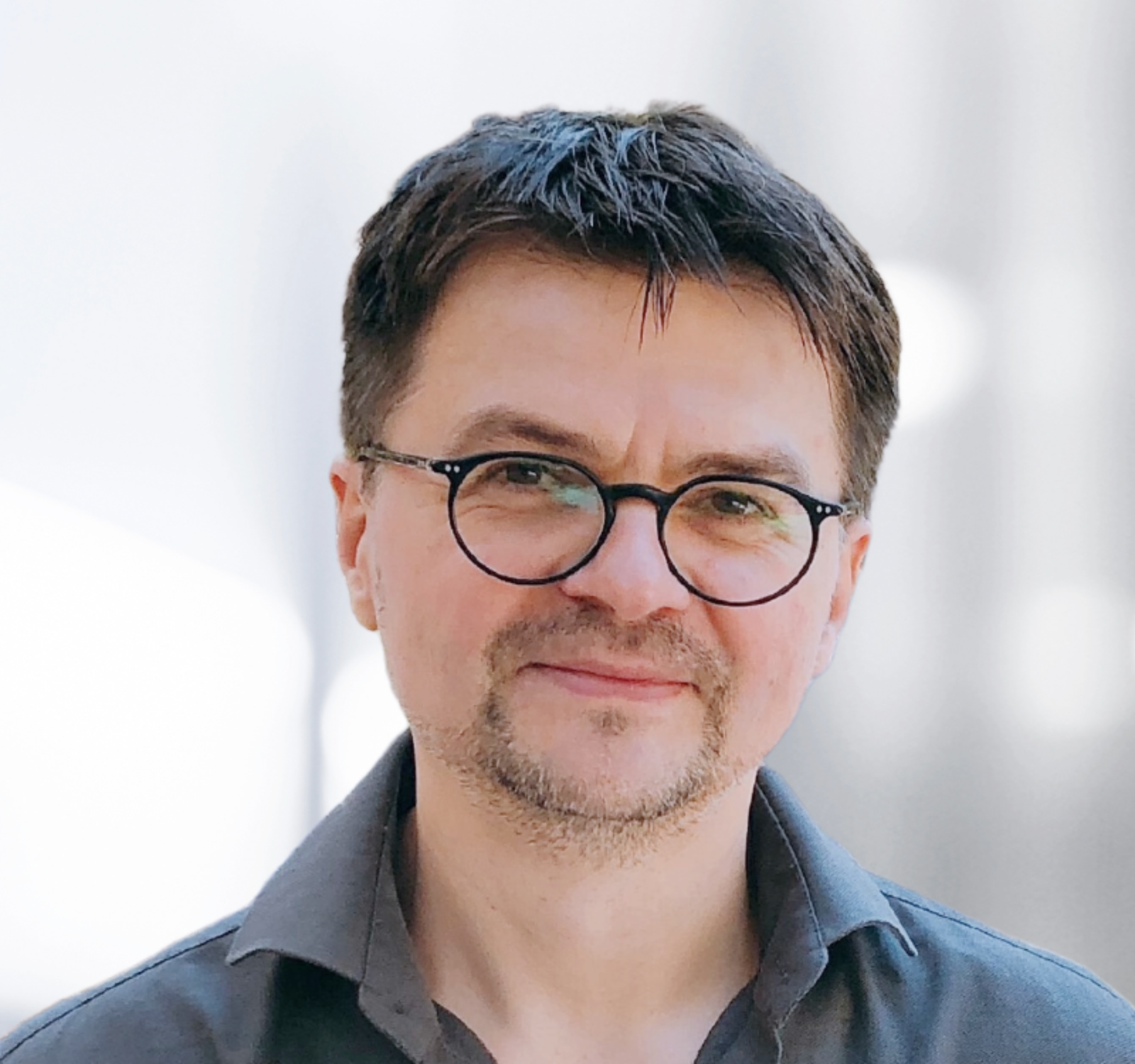
Andrej Rumiantsev

GENERAL CHAIR, 107TH ARFTG MICROWAVE MEASUREMENT CONFERENCE
ARFTG SECRETARY

Related